
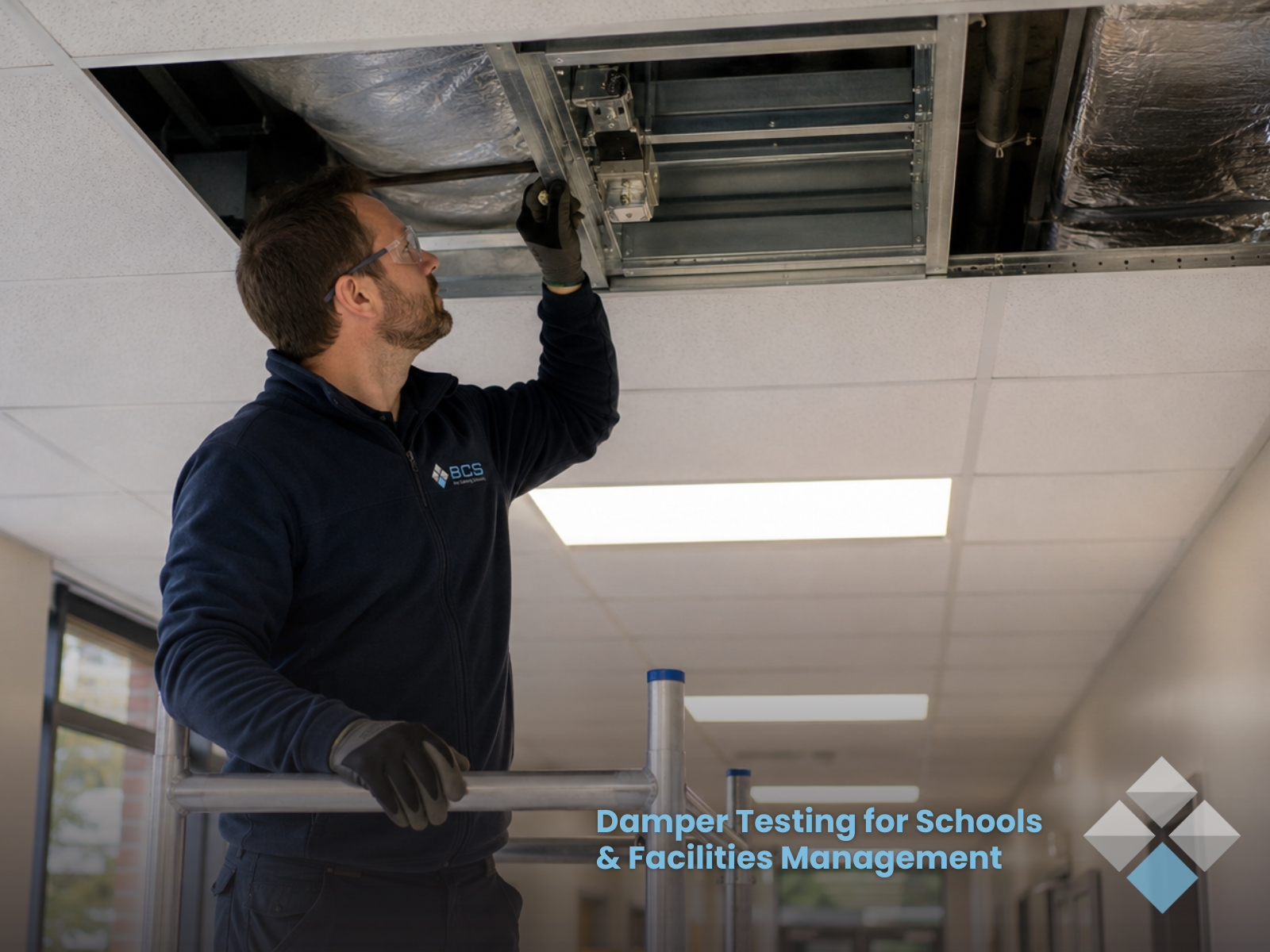
The quietest weeks may have passed, but early autumn is still a sensible time to check that hidden fire protection systems are working, recorded and ready for another busy year.
Summer closures are an obvious opportunity for maintenance. Schools are quieter, offices have fewer people in them and some commercial sites schedule planned downtime. It makes access easier, particularly where fire dampers sit above ceilings, behind panels or within busy working areas.
But August is not a fire safety deadline. If the summer window has been missed, the answer is not to leave fire damper testing until next year.
Early autumn gives facilities teams another useful decision point. Buildings are returning to fuller occupancy, ventilation and heating patterns are changing, and planned preventative maintenance schedules are being reviewed for the months ahead. It is a good time to confirm that fire dampers have been identified, tested and properly recorded, rather than assuming that a certificate somewhere in the file means everything is covered.
The latest government figures show why fire protection deserves continued attention. Fire and rescue services in England attended 13,679 fires in buildings other than dwellings in the year ending March 2026, an increase of 3.7% on the previous year.
Those figures do not tell us whether a fire damper operated correctly in any individual incident. They do show that fire in commercial and public buildings is not a remote or theoretical risk.
“Fire dampers are easy to forget because most people never see them. Testing is about proving that a hidden part of the building will actually do its job when it is needed, and being clear about any faults before they disappear into the maintenance file.”
Mark Biffin, Director at BCS
What is a fire damper protecting?
A building is divided into fire-resistant sections to help slow the movement of fire and smoke. This is known as compartmentation. Ventilation ductwork has to pass through some of those walls and floors, creating openings that could otherwise allow fire to travel from one part of the building to another.
Fire dampers are fitted at these points to help maintain the intended fire separation. Depending on the device, they may close in response to heat, smoke detection or a signal from the building’s fire-control system.
The term “fire damper” is often used loosely, but different devices have different functions and testing requirements.
| Type of device | What it is designed to do | What the inspection and testing plan should consider |
|---|---|---|
| Mechanical fire damper | Closes automatically, commonly through a thermally released mechanism, to resist the spread of fire through a duct or ventilation opening. | Access, physical condition, obstructions, blades or curtain, spring and release mechanism, full closure, reset and the condition around the installation. |
| Fire and smoke damper | Resists the spread of both fire and smoke. It may be linked to smoke detection, an actuator or the building’s control system. | The damper itself, actuator, control signal, fail-safe operation, full closure and reopening or reset, following the system design and manufacturer’s instructions. |
| Intumescent fire damper or air-transfer grille | Uses heat-reactive material that expands to close an opening during a fire. It may have no curtain or drop mechanism. | Condition, damage, contamination, clear air paths, correct installation and the inspection method specified by the manufacturer. A conventional drop test may not apply. |
| Smoke control damper | Forms part of an engineered smoke-control system, helping direct, contain or extract smoke during a fire. | Its role in the complete smoke-control strategy, including actuators, controls, cause-and-effect operation and system-specific testing. It should not be treated as interchangeable with a standard fire damper. |
This is why a competent inspection starts by establishing what is installed, where it is located and how it is supposed to operate. Applying the same test to every device can miss the point.
The annual testing point: law, standards and evidence
For premises in England and Wales, Article 17 of the Regulatory Reform (Fire Safety) Order 2005 requires the responsible person to ensure that relevant fire-safety facilities, equipment and devices are subject to a suitable system of maintenance and kept in efficient working order and good repair.
The legislation creates the duty. BS 9999:2017 provides the widely recognised testing benchmark, stating that fire dampers should be tested by a competent person when installation is complete and at least annually afterwards.
A more frequent inspection may be appropriate where the environment is particularly dusty or polluted, or where the fire strategy, risk assessment or manufacturer’s instructions require it.
Building regulations guidance also makes a practical point that is sometimes overlooked: access should be provided to the fire damper and its actuating mechanism for inspection, testing and maintenance. If a damper cannot be found or reached safely, it is difficult to demonstrate that it is being properly maintained.
This is not only a question of whether a damper closes on the day. BESA updated its DW145 guidance in 2024 after reports that annual maintenance work was uncovering dampers that had been incorrectly installed, damaged, never tested or made impossible to access.
A useful inspection therefore looks at the device in context, including visible installation issues and the fire-stopping around the duct penetration, not simply the moving parts.
What should a useful fire damper report contain?
A testing visit should leave the responsible person with evidence they can use. Depending on the building and system, that should include:
- A clear asset reference and location for each damper tested.
- The damper type and, where available, its specification.
- Confirmation that the device could be accessed safely.
- Checks for damage, contamination and obstructions.
- The correct functional test for the type of damper.
- Confirmation of full closure and successful reset, where applicable.
- Observations on actuators, release mechanisms, blades, frames and accessible penetration seals.
- A pass, fail or further-action result for each asset.
- Photographs and clear recommendations for remedial work.
- A record that can be aligned with the building’s PPM schedule, fire-risk actions, CAFM records or asset register.
“Facilities teams do not just need a certificate saying a visit took place. They need to know which damper was tested, where it is, whether it operated correctly and what needs to happen next. That is what makes the report useful for the PPM schedule and the next inspection.”
Liam Hodgson, Client Services Manager at BCS
Where previous records are incomplete, the first visit may involve more than testing. Dampers may need to be located and mapped, access problems recorded and an accurate asset list established. That initial work is valuable because it gives future testing a reliable baseline.
Why early autumn can still be the right time
Fire dampers do not become more important because the calendar changes. The practical autumn opportunity comes from the way buildings are used.
Schools return to full timetables. Offices become busier after the holiday period. Hotels, care settings, healthcare facilities, retail sites and manufacturers move into different seasonal operating patterns. Ventilation and heating systems may run for longer or change mode, while maintenance teams begin preparing buildings for the colder months.
That makes early autumn a sensible point to ask:
- When were our fire dampers last tested?
- Does the report account for every known damper?
- Are any assets inaccessible, failed or awaiting remedial work?
- Have alterations to ductwork, ceilings or room layouts affected access?
- Do the records match the current fire-risk assessment and asset register?
- Is the next test already included in the PPM programme?
Testing can often be planned around the building rather than waiting for a complete shutdown. Depending on access and the site, work may be scheduled by floor or area, during quieter periods, outside core hours or alongside other ventilation hygiene and high-level access work.
The important thing is not to turn a missed summer slot into a twelve-month delay.
BCS provides fire damper inspection, testing and reporting for commercial, hospitality, healthcare, retail, accommodation and industrial premises across the UK. If your records are incomplete, your annual test is due or you need help establishing what is installed, speak to the BCS team about a practical testing plan for your building.
