
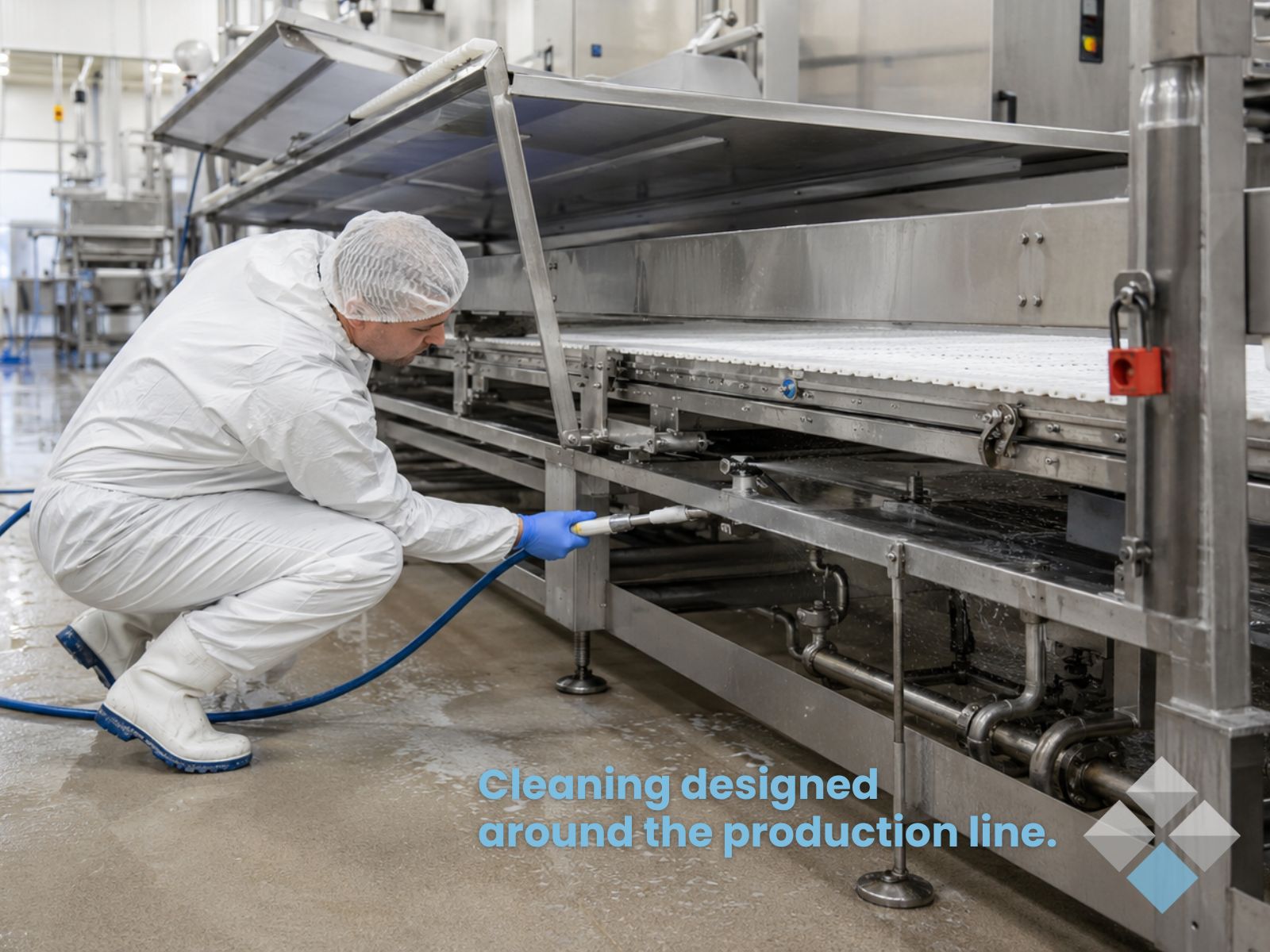
Water can be one of the most effective cleaning tools in a food factory. In the wrong part of the factory, it can damage equipment, spread residue or introduce a new hygiene risk. A specialist clean should begin with the product, the process and the environment, not a default method.
“Deep clean the line” can sound like a clear instruction. In practice, it leaves some of the most important questions unanswered.
What is being removed? Is it a sticky protein, oil, flour, seasoning, sugar, chocolate or a mixture of residues? Is the equipment designed to be washed down? Are there electrical components, bearings or sensors that must remain dry? Is there a drain route? Could water turn a dry powder into a paste that is harder to remove? Does the area carry an allergen or combustible-dust risk?
Until those questions have been answered, “deep clean” describes the desired result, but not a safe or effective method.
This is particularly relevant to the food and drink manufacturing sector in Wales. The Welsh Government’s 2025 Economic Appraisal records 650 food and drink manufacturing business units, with sector turnover of £6.8 billion in 2025 and 25,000 people employed in 2024. That includes very different environments, from bakeries and dairy plants to meat processing, prepared foods, drinks and confectionery.
The cleaning approach that works well in one of those environments may be completely wrong in another.
“The first question should not be, ‘How quickly can we wash this down?’ It should be, ‘What is the residue, how is the line designed and what does the site’s hygiene plan allow?’ Once those points are clear, you can choose a method that removes the problem without creating another one.”
Mark Biffin, Director at BCS
Wet cleaning is powerful, but it is not universal
Wet cleaning can be highly effective where equipment and production areas are designed for it. Water, a site-approved cleaning chemical, mechanical action and a controlled rinse can help lift sticky, fatty or protein-based residues from suitable surfaces. Temperature, chemical concentration, the effort applied and contact time can all affect the result.
The evidence is useful here. An FSA-commissioned review of food-allergen cleaning found that wet cleaning was generally more effective at removing allergen residues than dry cleaning. It also found that there is no single cleaning method that works for every food and every surface. Effectiveness varies with the food residue, its physical form, the material and condition of the surface, accessibility, temperature, cleaning chemical, concentration, time and mechanical action.
That last point matters. Water alone is not automatically an effective clean, and more water is not necessarily a better clean.
In a washdown area with appropriate drainage, water can carry loosened material away. Around equipment that is not designed to get wet, the same approach can drive moisture into bearings, motors, control panels, sensors, voids and difficult-to-dry spaces. Poorly controlled spray can also move residue from one area to another or leave standing water behind.
There are residues that react badly to the wrong temperature or become more difficult to remove once wetted. Flour and other powders can form paste. Sugar can dissolve and travel into small gaps before drying again. A strong jet may spread contamination or create aerosols rather than contain the work.
Wet cleaning therefore needs a defined boundary. The scope should identify what can be washed, what must be protected, the chemicals and concentrations permitted by the site, how run-off will be controlled, the rinse and drying method, and who will confirm that the area is ready to return to production.
When keeping water out is part of the control
Dry cleaning is not simply a quicker version of wet cleaning. In some production environments, it is a deliberate part of the site’s hygiene and safety controls.
Bakeries, mills, cereal plants, powdered-ingredient areas and some confectionery operations can contain residues that are better removed without introducing water. Suitable methods may include controlled scraping, brushing, dismantling and specialist vacuuming, depending on the product, equipment and the site’s risk assessment.
The word “suitable” is doing important work. Fine food powders can present more than a hygiene issue. HSE guidance on dust explosions in the food industry identifies flour, sugar, custard powder, dried milk, instant coffee, potato powder and soup powder as examples of potentially explosible dusts. Its cleaning guidance advises against sweeping brushes and compressed air for dusty cleaning and points to fully earthed vacuum systems.
That means an ordinary industrial vacuum or a method that throws dust back into the air may be inappropriate. Equipment and procedures have to match the material, the area classification and the site’s controls under the Dangerous Substances and Explosive Atmospheres Regulations, where they apply.
Dry methods have limitations too. They may not remove a sticky film, fat or protein residue effectively. Brushes, scrapers and vacuum tools can themselves transfer residue between areas if they are not properly controlled. A surface that looks free of visible powder may still need the manufacturer’s agreed allergen verification.
The practical question is not whether wet cleaning or dry cleaning is “best”. It is which method, or carefully managed sequence of methods, is appropriate for that particular line.
| Production condition | Method that may be considered | Points to resolve before work starts |
|---|---|---|
| Sticky, fatty or protein-based residue in a washdown area | Controlled wet cleaning using the site’s approved chemical process | Surface compatibility, concentration, contact time, mechanical action, rinse, drainage and complete drying |
| Flour, starch, sugar or seasoning in a dry-process area | Dry removal and suitable specialist vacuuming | Combustible-dust assessment, correct vacuum specification, dust containment and avoiding compressed air or uncontrolled sweeping |
| Sensitive electrical or automated equipment | Dry cleaning or tightly controlled low-moisture work | Isolation, manufacturer guidance, protection of sensors, motors and controls, and agreed access boundaries |
| Mixed equipment with both washable and sensitive sections | Zoned or staged cleaning using more than one method | Clear separation of wet and dry zones, the order of work, protection of completed areas and responsibility for handback |
| Known allergen residue | A site-validated method appropriate to the allergen, food matrix and surface | Cleaning validation, segregation of tools, dismantling needs and the manufacturer’s verification and line-release procedure |
| Residue inside guards, framework or enclosed machinery | The appropriate wet or dry method after safe access is created | Isolation, stored energy, authorised guard removal, reassembly and inspection before restart |
The table is not a substitute for a site-specific method statement. Its purpose is to show why the cleaning method cannot be selected from the appearance of the residue alone.
Allergen clean is not the same as microbiologically clean
Allergen control is one of the clearest examples of why the method and the evidence have to match the risk.
Allergens are proteins. They cannot simply be “killed” in the way people sometimes describe destroying bacteria. The FSA review makes the distinction clearly: a surface that is microbiologically clean is not necessarily allergen clean.
The food business must therefore determine what an acceptable result looks like for its product and process. A cleaning method may need to be validated in advance, then verified in routine use through the site’s approved controls. Depending on the risk, that might include visual inspection, allergen-specific swabs or other testing selected by the manufacturer.
Photographs remain useful. They can show the area before and after contractor work, identify what was opened or accessed, and record visible defects or exclusions. They cannot, by themselves, prove that allergenic protein or a microbiological hazard has been removed.
This is also why cleaning tools, waste routes and the order of work matter. A vacuum hose, brush, cloth or removed machine part can become a route for cross-contact if it moves between zones without the controls set by the site.
A better specification starts before the cleaning team arrives
A useful scope does more than list the assets to be cleaned. It should explain the operating conditions around the work.
For specialist cleaning on or around a production line, BCS would normally expect the manufacturer, hygiene team, engineering team and contractor to agree points such as:
- The product residues and allergens associated with the area.
- Whether the environment is wet, dry or divided into controlled zones.
- Which cleaning methods and chemicals are permitted.
- Which machinery must be isolated and who has authority to isolate it.
- Whether guards or components need to be removed, and who will remove and replace them.
- Components that must remain dry or be separately protected.
- Drainage, dust containment, waste removal and segregation requirements.
- The order in which areas will be cleaned to avoid recontamination.
- The manufacturer’s inspection, verification and line-release process.
- The records needed after the work, including photographs, exceptions and remedial actions.
HSE guidance on food-processing machinery reports that conveyors are involved in 30% of machinery accidents in the food and drink industries. Any cleaning that requires access near belts, rollers, blades, trapping points or removed guards must sit within a formal safe system of work. Wet or dry method selection never overrides safe isolation.
“Good specialist cleaning is often about restraint as much as effort. The team needs to know where water can be used, where dust must be contained and where the line has to be opened safely. That planning gives the hygiene manager a much clearer handback at the end.”
Liam Hodgson, Client Services Manager at BCS
BCS provides specialist cleaning for food manufacturing and production environments across the UK. Its teams can work on fixed and moveable assets using wet, dry or combined methods agreed for the site, with photographic reporting and clear records of the completed scope.
The starting point is not a generic promise to “deep clean everything”. It is a site-specific conversation about the product, residue, machinery, access and risk controls. Get the method right first, and the clean is more likely to be safe, effective and useful to the people responsible for releasing the line back into production.
Sources and further reading
- Welsh Food and Drink Economic Appraisal 2025
- Food Standards Agency: Food hygiene for businesses
- Food Standards Agency: Review of food-allergen cleaning literature and guidance
- Health and Safety Executive: Preventing dust explosions in the food industry
- Health and Safety Executive: Food-processing machinery
