

Delivery-only kitchens have become a normal part of the UK food service landscape. Some operate from industrial units, some sit behind familiar restaurant brands, and some run several virtual food brands from the same kitchen.
From a customer’s point of view, the experience is simple. They order through an app, the food arrives, and the physical kitchen behind the meal is often invisible.
For operators, landlords and facilities teams, it is not that simple.
A delivery-only kitchen is still a commercial kitchen. It still produces grease, heat, steam, food debris, waste and fire risk. It still needs to be suitable for food preparation, ready for inspection and supported by cleaning records that show the right work has been carried out.
The difference is that delivery-only kitchens can often run at a very intense pace, especially where several menus, brands or platforms are being handled from one site. That operating pattern matters, because cleaning schedules should be based on how the kitchen is actually used, not whether customers ever walk through the door.
“The biggest mistake with delivery-only kitchens is thinking of them as somehow lighter than a normal restaurant kitchen. In reality, some of these sites are working extremely hard, with constant cooking, fast turnarounds and very little downtime. The cleaning schedule has to reflect that.”
Liam Hodgson, Client Services Manager at BCS
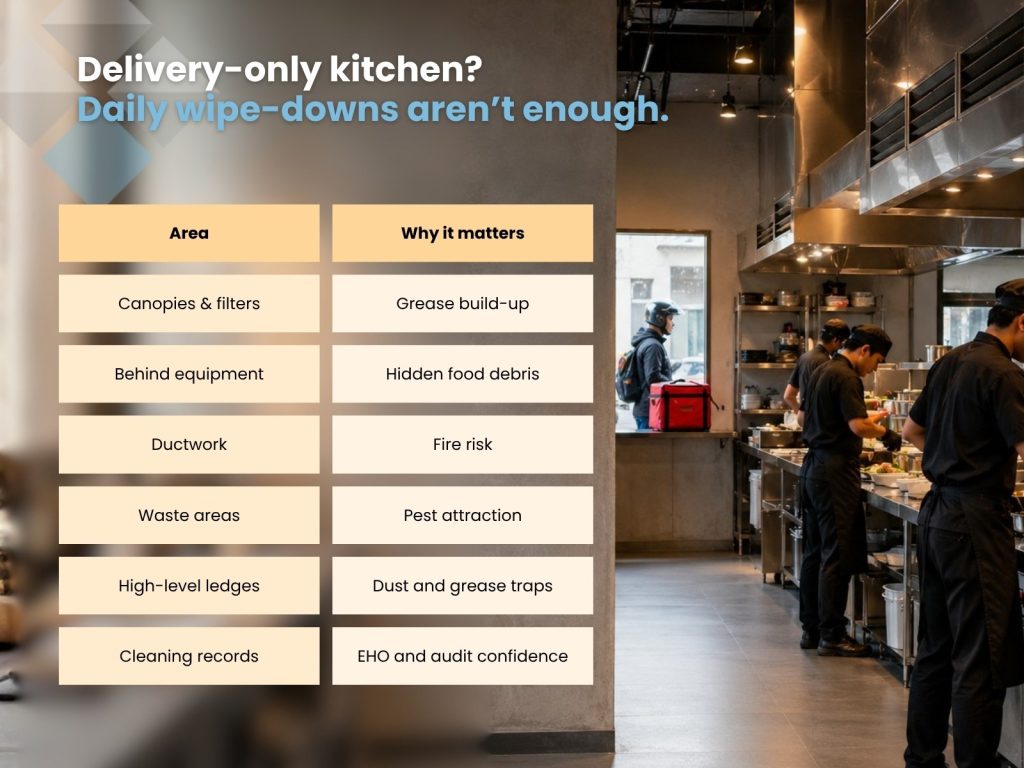
Daily cleaning is important, but daily cleaning alone is not usually enough. Staff can wipe surfaces, clean prep areas, empty bins, sweep floors and keep the kitchen moving, but there are always areas that become harder to reach during service. Grease builds behind cooking equipment. Dirt collects under units. Canopies, filters and ductwork need proper attention. Walls, floors, high-level ledges and waste areas can all deteriorate if they are not part of a planned cleaning routine.
That is where a proper delivery-only kitchen cleaning checklist becomes useful.
It gives operators, landlords and facilities teams a simple way to separate routine cleaning from periodic deep cleaning, specialist extract cleaning and evidence-led compliance work.
What should be included?
A good delivery-only kitchen cleaning plan should cover more than the obvious food preparation surfaces. It should look at the whole working environment, including the areas staff see every day and the areas that only become visible when equipment is moved, access panels are opened or the kitchen is taken out of service for deeper cleaning.
| Area | What to check | Why it matters |
|---|---|---|
| Cooking equipment | Grease, carbon build-up, food debris, backs and sides of equipment | Helps reduce hygiene issues, odours, pest attraction and fire risk |
| Floors and walls | Grease film, food debris, staining, corners, edges and areas under equipment | These areas can deteriorate quickly in high-volume kitchens |
| Prep surfaces and sinks | Cleanable surfaces, seals, splashbacks, surrounding walls and fittings | Supports day-to-day food hygiene and inspection readiness |
| Canopies and filters | Grease deposits, filter condition, access and cleaning frequency | Visible build-up can indicate heavier grease loading across the system |
| Ductwork and fans | Internal grease accumulation, access limitations and cleaning records | Important for fire risk management and TR19-focused cleaning |
| High-level areas | Ledges, pipework, vents, light fittings and dust traps | Dirt and grease can collect above the normal cleaning line |
| Waste and dispatch areas | Bins, external waste points, spillages, packaging build-up and traffic routes | Delivery kitchens often create heavy packaging and food waste flow |
| Shared spaces | Corridors, shared extraction areas, back-of-house routes and landlord-controlled areas | Responsibility can become unclear where several operators use the same site |
| Records and evidence | Reports, photos, certificates, next due dates and recommendations | Helps operators show that cleaning has been planned and completed properly |
The exact list will depend on the site. A small delivery-only kitchen producing a limited menu will not have the same risk profile as a high-volume kitchen running several brands, fryers, grills and late-night delivery services. The important point is that the cleaning plan should be based on actual use, cooking methods, hours of operation, grease load and building layout.
A delivery-only kitchen that cooks for six or seven evenings a week may need a different level of attention to a lighter-use site. A kitchen using fryers, chargrills or wok cooking may create heavier grease deposits than a site focused mainly on chilled prep or reheating. A shared kitchen space may also need clearer responsibilities, especially where extraction systems, waste areas or access routes are controlled by a landlord or facilities manager.
This is why a “standard clean” is not always enough. The operator needs to know what is being cleaned, how often, by whom, and what evidence is being kept.
Extract cleaning is one of the most important areas to get right. In any commercial kitchen, grease-laden vapour is drawn up through the canopy, filters, ductwork and fan system. What can be seen from the kitchen floor is only part of the issue. Grease can accumulate inside the ductwork, where it is much harder to inspect without proper access.
TR19 Grease is widely used as the industry specification for managing fire risks associated with grease accumulation in commercial kitchen extraction systems. For delivery-only kitchens, this matters because the cooking pattern can be different from a traditional restaurant. The site may have longer operating hours, fewer quiet periods and a higher concentration of orders in a smaller space.
If the extraction system is shared, the responsibility needs to be especially clear. Operators, landlords and facilities teams should know who arranges the cleaning, who holds the reports, who reviews recommendations and who makes sure the next clean is scheduled.
“When we look at delivery-only kitchens, we are not just thinking about whether the kitchen looks clean on the day. We are looking at how grease, dirt and access issues build up over time, and whether the operator has the right records to show that the work has been done properly.”
Mark Biffin, Director at BCS
The same principle applies to kitchen deep cleaning. A proper deep clean should go beyond a surface-level tidy-up. It may include moving equipment where practical, degreasing hard-to-reach areas, cleaning behind and beneath units, tackling walls and floors, removing built-up dirt around cooking lines and giving the kitchen a reset that daily cleaning cannot achieve on its own.
For delivery-only sites, this can be especially valuable because the kitchen may not have the natural pauses that come with a more traditional restaurant day. If orders are coming in continuously, cleaning can become something that is squeezed around service rather than properly planned. Over time, that creates pressure.
Shared spaces are another area that can be overlooked. Delivery-only kitchens often rely on back-of-house corridors, dispatch areas, storage rooms, waste routes, loading areas and sometimes shared building systems. These areas may not be part of the main cooking line, but they can still affect hygiene, safety, pest control and the overall condition of the site.
Where several brands operate from the same kitchen, or where several operators work from the same building, responsibility should not be left vague. A simple responsibility matrix can help prevent gaps. The operator may handle day-to-day food hygiene and kitchen cleaning, while the landlord or facilities manager may have responsibility for shared plant, access arrangements or building-level systems. Head office may also need consistent records if the delivery kitchen forms part of a wider estate.
How often should a delivery-only kitchen be professionally cleaned? There is no single answer that fits every site.
The right frequency depends on the type of cooking, trading hours, volume of orders, grease production, equipment layout, ductwork access, previous cleaning condition and any requirements from insurers, landlords or internal compliance teams. Some sites may need periodic deep cleaning quarterly or twice a year. Higher-risk or heavier-use sites may need more frequent attention. Extract cleaning frequency should be based on proper assessment of the system and its use, not guesswork.
The key is to move away from reactive cleaning. If a kitchen only books specialist cleaning when there is a problem, a complaint, an odour, visible grease or an inspection concern, the site is already on the back foot. Planned cleaning gives operators more control. It helps reduce disruption, supports compliance records and makes it easier to budget for the work.
The evidence matters too.
Good cleaning records should include clear reports, before-and-after photographs, certificates where relevant, notes on access limitations, recommendations for follow-up work and a clear next due date. This is useful for operators, but it is also useful for landlords, facilities teams, insurers and head office teams who may need a reliable view across several sites.
For delivery-only kitchens, the customer may never see the kitchen. But other people might. Environmental Health Officers, landlords, insurers, fire safety professionals, auditors and facilities managers all have a legitimate interest in how the site is being maintained.
A strong cleaning checklist helps keep that responsibility visible.
Delivery-only kitchens are not second-class kitchens. They are busy commercial food environments, often working under pressure and producing the same hygiene, grease and fire risks as any other food operation. In some cases, the pressure may be greater because of volume, speed and the lack of natural downtime.
BCS works with commercial kitchens, delivery-only kitchen operators, hospitality businesses and food environments across the UK, providing specialist kitchen deep cleaning, TR19-focused extract cleaning, high-level cleaning, HVAC cleaning and related compliance-led services.
If your delivery-only kitchen needs a planned cleaning schedule, clearer records or a proper review of what should be included, BCS can help build a practical programme around the way your site actually operates.
References:
Food Standards Agency – Getting ready to start your food business
Food Standards Agency – Food hygiene for your business
Food Standards Agency – Preparing for your first food hygiene inspection
BESA – TR19 Grease, Fire Risk Management for Kitchens
