
Open a delivery app and it is easy to think the food comes from a familiar restaurant, a high street kitchen or a branded takeaway counter.
Increasingly, that is not always the case.
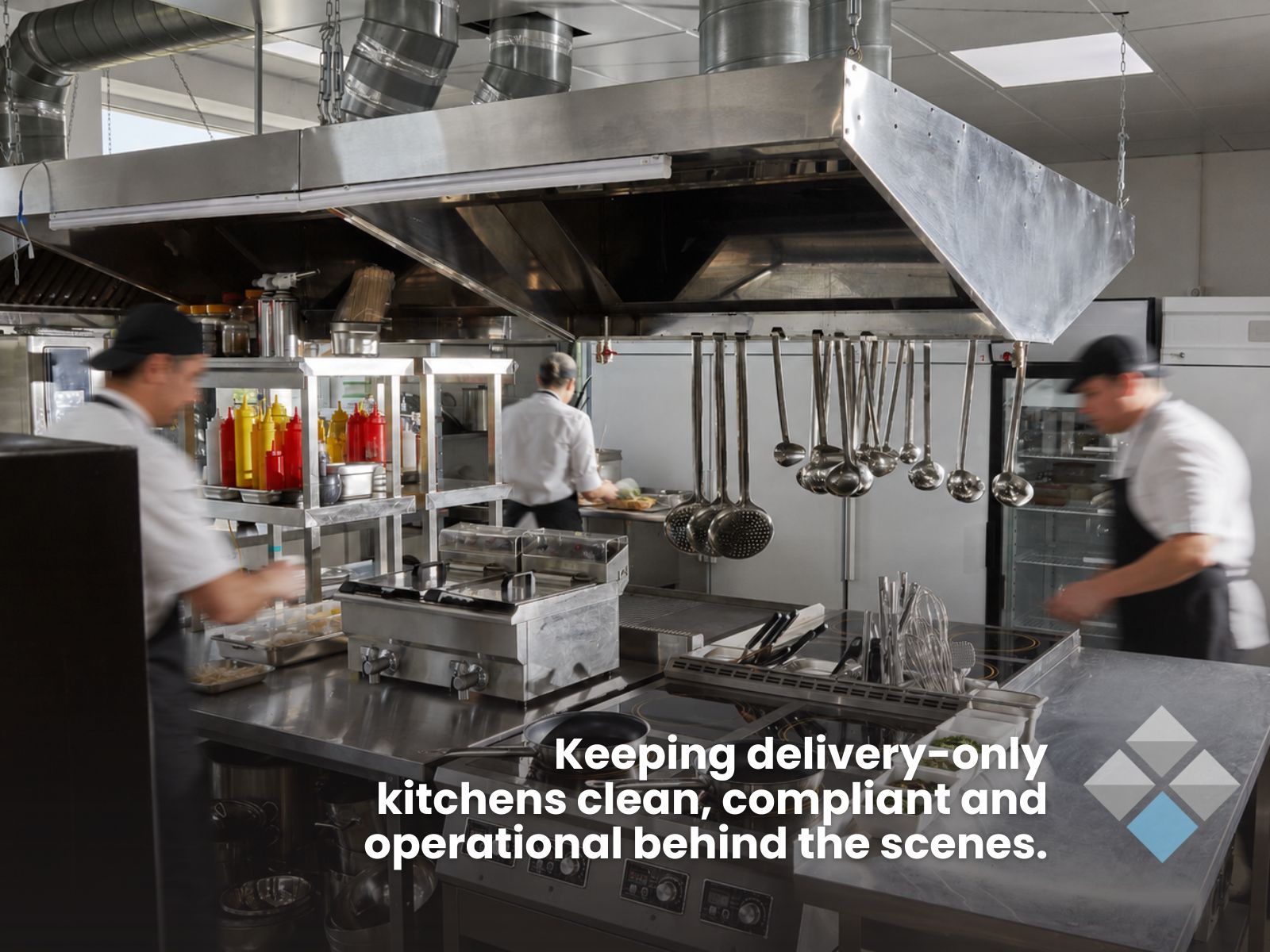
Across the UK, delivery-only kitchens have become a normal part of the food service landscape. These sites may have no dining area, no front counter and no public-facing shopfront, but they are still commercial kitchens. They still produce grease, heat, steam, food waste and hygiene risk, often at high volume and under tight time pressure.
Recent research reported by The Guardian found that one in seven food delivery businesses in England operating on major delivery platforms were dark kitchens, with researchers raising concerns around visibility, regulation and consumer transparency.
For operators, landlords and facilities teams, the message is simple: out of sight should not mean out of mind.
Delivery-only does not mean lower risk
A “ghost kitchen” can be a smart operating model. It can reduce front-of-house costs, support multiple brands from one site, and allow food businesses to serve areas where they may not have a traditional restaurant presence. But from a cleaning and compliance perspective, the absence of customers on site does not reduce the demands placed on the kitchen.
In some cases, the opposite is true.
Delivery-only sites can work intensely, with orders arriving continuously through multiple platforms, several menus being prepared in the same space, and staff moving quickly between fryers, grills, prep benches, ovens and dispatch areas. The pace of work can make routine cleaning harder to maintain, while the lack of a customer-facing area can sometimes make standards feel less visible day to day.
That is where risk can build quietly.
A customer may never walk through the door, but an Environmental Health Officer, insurer, landlord, fire officer or facilities manager still might. The Food Standards Agency’s Food Hygiene Rating Scheme is designed to give clear information about hygiene standards in food businesses, and local authority food safety officers inspect businesses to check that food hygiene law is being followed.
For a delivery-only kitchen, that means the basics still matter: cleanable surfaces, controlled food preparation areas, well-maintained equipment, suitable waste management, clear records, and a cleaning regime that reflects the way the site is actually being used.
Liam Hodgson, Client Services Manager at BCS, explains:
“Delivery-only kitchens can be incredibly busy environments. The public may never see them, but from a cleaning and compliance point of view they should be treated with the same seriousness as any commercial kitchen. In some cases, the pressure on extraction, equipment and surfaces can be even higher because the site is built around volume and speed.”
Daily cleaning has an important role, but it cannot always reach the areas where grease, carbon, dirt and food debris gradually accumulate. Behind equipment, around cooking lines, beneath units, around extraction canopies, on walls and floors, and in harder-to-access areas, periodic specialist cleaning helps reset the kitchen properly and gives operators greater confidence that standards are being maintained.
Daily cleaning keeps the kitchen moving. Periodic deep cleaning helps bring it back under control.
Extract systems still need proper attention
One of the biggest risks in any commercial kitchen is grease accumulation inside the extraction system. Delivery-only kitchens are no exception.
Every time food is cooked, particularly where frying, grilling, chargrilling, wok cooking or high-volume production is involved, grease-laden vapour is drawn into the canopy, filters, ductwork and fan system. What is visible at canopy level is only part of the picture. The more serious build-up can sit further inside the ductwork, where it is harder to see without proper inspection access.
BESA describes TR19® Grease as the specification for managing fire risks associated with grease accumulation in commercial kitchen extraction systems. For operators, landlords and insurers, this is not just about appearance. It is about reducing fire risk, keeping cleaning frequencies appropriate, and being able to evidence that the system has been cleaned properly.
This is particularly important in delivery-only kitchens because the cooking pattern may be very different from a traditional restaurant. A high street restaurant may have clear lunch and evening peaks, with some quieter periods between services. A delivery-only kitchen may run longer hours, support multiple virtual brands from one line, or operate with a more constant flow of orders during evenings and weekends.
That usage should influence the cleaning schedule.
A light-use kitchen and a high-volume delivery site should not automatically be treated the same. The right frequency depends on cooking type, hours of use, grease load, layout, ductwork access and the wider fire-risk profile of the building. Where multiple operators share a site, it is also important to be clear about who is responsible for the extraction system, who holds the cleaning records, and how issues are reported and resolved.
Mark Biffin, Director at BCS, says:
“The biggest risk with delivery-only kitchens is assuming that because they are out of sight, the standards can somehow be lighter. Grease build-up, hygiene issues and fire risk do not care whether a customer sits down in the building or orders through an app. What matters is proper cleaning, planned maintenance and clear evidence that the work has been done.”
That evidence is a key part of good management. Before-and-after photography, cleaning reports, certificates, access notes and recommendations all help operators demonstrate that work has been carried out, while also helping facilities teams plan future maintenance instead of reacting when problems appear.
A practical approach for operators, landlords and facilities teams
The most effective approach is not to treat delivery-only kitchens as unusual or separate from other commercial kitchens. They should be managed with the same discipline, but with cleaning schedules and reporting built around their specific operating pattern.
That starts with understanding the site properly.
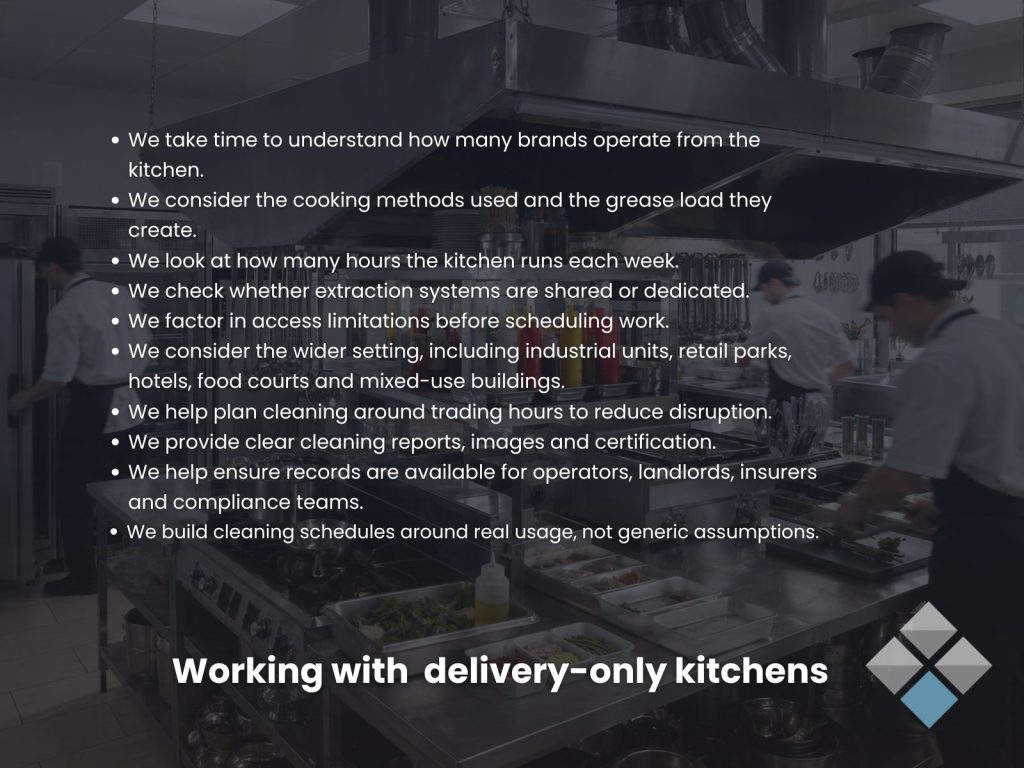
How many brands operate from the kitchen? What cooking methods are used? How many hours does the kitchen run each week? Is the extraction system shared? Are there any access limitations? Is the site part of a wider building, industrial unit, retail park, hotel, food court or mixed-use facility? Are cleaning reports being stored in a way that the right people can access them when needed?
Those questions matter because delivery-only sites often involve more than one interested party. The operator may be responsible for food safety and day-to-day cleanliness, while the landlord or facilities manager may have an interest in building risk, extraction infrastructure, fire safety and insurance evidence. Where the site is part of a multi-site food brand or franchise model, head office may also need consistent reporting across several locations.
A simple responsibility check can help:
| Responsible party | What they need to keep under control |
|---|---|
| Operator | Day-to-day hygiene, kitchen deep cleaning, food safety standards and EHO readiness |
| Landlord | Building risk, shared extraction systems, access arrangements and evidence of maintenance |
| Facilities manager | Planned cleaning schedules, records, contractor coordination and follow-up actions |
| Brand owner | Consistent standards across delivery-only and customer-facing sites |
| Insurer or compliance team | Cleaning evidence, certification and clear records after inspection or incident |
BCS supports commercial kitchens, delivery-only sites and multi-site food operators with specialist cleaning services across the UK, including kitchen extract cleaning, kitchen deep cleaning, high-level cleaning, HVAC cleaning and fire damper testing. Their work is particularly relevant where cleaning needs to be planned, evidenced and repeated across busy operational environments.
For delivery-only kitchens, that means building a cleaning schedule that reflects real use, not assumptions.
A practical schedule may include routine kitchen deep cleaning, TR19-focused extract cleaning, filter and canopy attention, periodic high-level cleaning, and documented reporting after each visit. Where issues are found, such as poor access, heavy grease deposits, damaged filters, hygiene concerns or areas that need more frequent attention, those findings should be captured clearly so the operator can make informed decisions.
The rise of delivery-only kitchens is not going away. For many food businesses, the model makes commercial sense, and for customers, it offers speed, choice and convenience. But behind every delivery order is still a physical kitchen, with real equipment, real staff, real grease and real compliance responsibilities.
Delivery-only kitchens may be hidden from the high street, but they should never be hidden from proper cleaning, maintenance and reporting.
BCS works with commercial kitchens, hospitality operators, food environments and facilities teams across the UK, helping sites stay cleaner, safer and better prepared for inspection through planned specialist cleaning and clear compliance records.
references:
https://www.theguardian.com/business/2026/jan/31/one-in-seven-food-delivery-businesses-england-dark-kitchens
