Growth is a good problem to have, but it changes the cleaning problem very quickly.
A restaurant group with three sites can usually manage cleaning through local contacts, site managers and a few trusted suppliers. A food retail brand with five locations may still know exactly who cleaned what, when each job was done, and which site needs attention next.
By the time that same business reaches ten, twenty or fifty sites, the picture starts to change.
The work itself may not be dramatically different from one location to another. Kitchens still need deep cleaning. Extraction systems still need planned inspection and cleaning. Front-of-house spaces still need to present well. Fire dampers, HVAC systems, high-level areas and back-of-house spaces still need to be managed properly.
What changes is the level of coordination required. More sites means more managers, more opening hours, more building layouts, more landlords, more regional differences and more records to keep on top of. What started as a practical local arrangement can become difficult to control, especially when the business is opening new sites while also trying to maintain standards across the existing estate.
For growing hospitality, food retail, leisure and food production brands, cleaning eventually becomes less of a single-site task and more of an operational programme.
“The point where things usually change is not when a company becomes huge. It is often much earlier than that. Once you have enough sites that no one person can hold the whole picture in their head, you need a cleaning partner that can give you structure, reporting and consistency.”
Liam Hodgson, Client Services Manager at BCS
Local contractors can work very well for single sites and small clusters. In fact, many growing chains begin that way. One contractor covers the first site, another helps with a new branch in another city, and a site manager knows someone reliable for the next location.
At first, that can feel flexible. It can also feel cost-effective.
The difficulty comes when the business starts needing consistency. Different suppliers may work to different standards, provide different reports, use different terminology and respond at different speeds. Some may be excellent technically but poor at paperwork. Others may be fine for general cleaning but not equipped for specialist kitchen extract cleaning, fire damper testing, HVAC deep cleaning or high-level work.
This is where head office can lose visibility.
A site may believe a clean has been done, but the report is missing. A kitchen extract system may be overdue, but the date sits in a local inbox rather than a central PPM schedule. A new opening may need a pre-launch deep clean, but no one has connected that requirement to the wider maintenance plan. A landlord may ask for evidence, but the certificate is not easy to find.
None of these issues have to be dramatic on their own. The problem is accumulation. As the estate grows, small gaps become harder to spot and more time-consuming to fix.
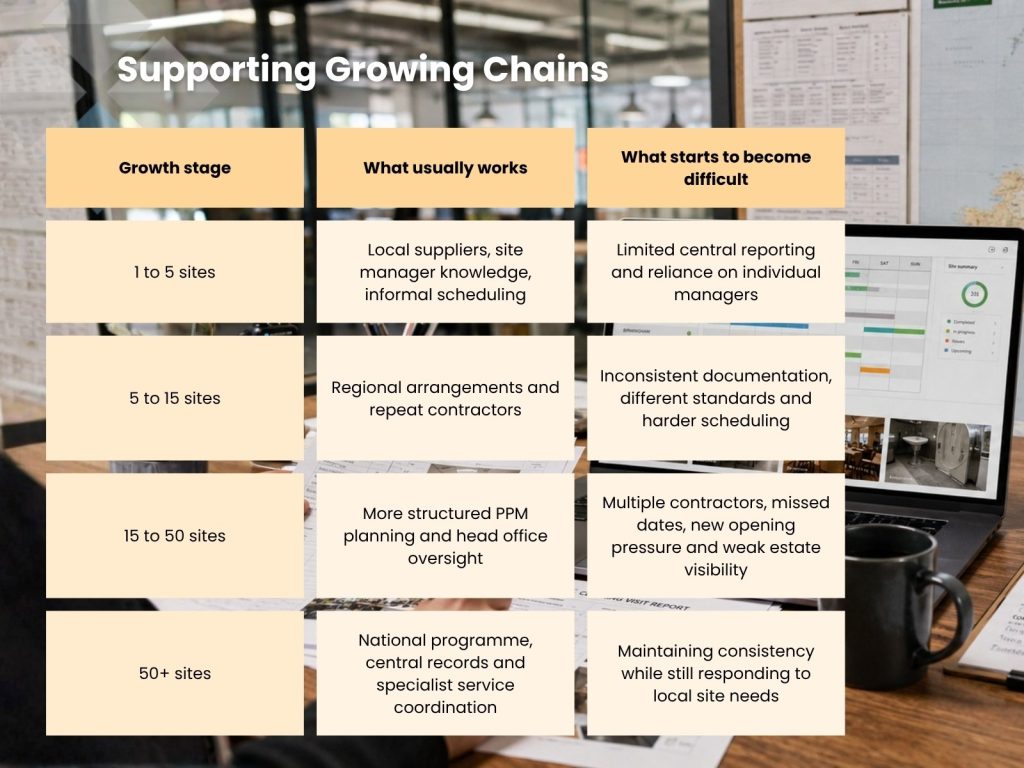
| Growth stage | What usually works | What starts to become difficult |
|---|---|---|
| 1 to 5 sites | Local suppliers, site manager knowledge, informal scheduling | Limited central reporting and reliance on individual managers |
| 5 to 15 sites | Regional arrangements and repeat contractors | Inconsistent documentation, different standards and harder scheduling |
| 15 to 50 sites | More structured PPM planning and head office oversight | Multiple contractors, missed dates, new opening pressure and weak estate visibility |
| 50+ sites | National programme, central records and specialist service coordination | Maintaining consistency while still responding to local site needs |
The issue is not just administration. Poor coordination can affect compliance, safety and brand standards.
For food businesses, hygiene standards matter at every location. The Food Hygiene Rating Scheme gives customers clear information about hygiene standards following local authority inspections, and while ratings are site-specific, the reputational impact is rarely contained neatly to one branch when a brand name is involved.
For non-domestic premises, fire safety responsibilities also need to be understood and managed. Employers, owners, landlords, occupiers and facilities managers can all have responsibilities depending on control of the premises. Where there is more than one responsible person, they need to work together. That matters for growing chains because responsibility can become more complicated when sites are leased, managed regionally or fitted out in different ways.
In practical terms, cleaning has to support that wider duty of care.

Kitchen extract cleaning is a clear example. Grease builds up in canopy filters, ductwork, fans and internal surfaces over time. If systems are not inspected and cleaned at the right intervals, the issue becomes a fire risk as well as a hygiene and operational concern. TR19 Grease is widely used as the industry specification for managing fire risk associated with grease accumulation in commercial kitchen extraction systems, and growing chains need a way to know that each relevant site is being managed properly.
That does not mean every site needs the same frequency or exactly the same scope of work. A busy city-centre kitchen using fryers and grills may have very different grease loading from a lighter-use site with a smaller menu. A food production space, pub kitchen, supermarket bakery, delivery-only kitchen or healthcare catering area may each need a slightly different cleaning plan.
The point is that those differences should be known, recorded and built into a planned schedule.
A growing chain does not need overcomplication. It needs control.
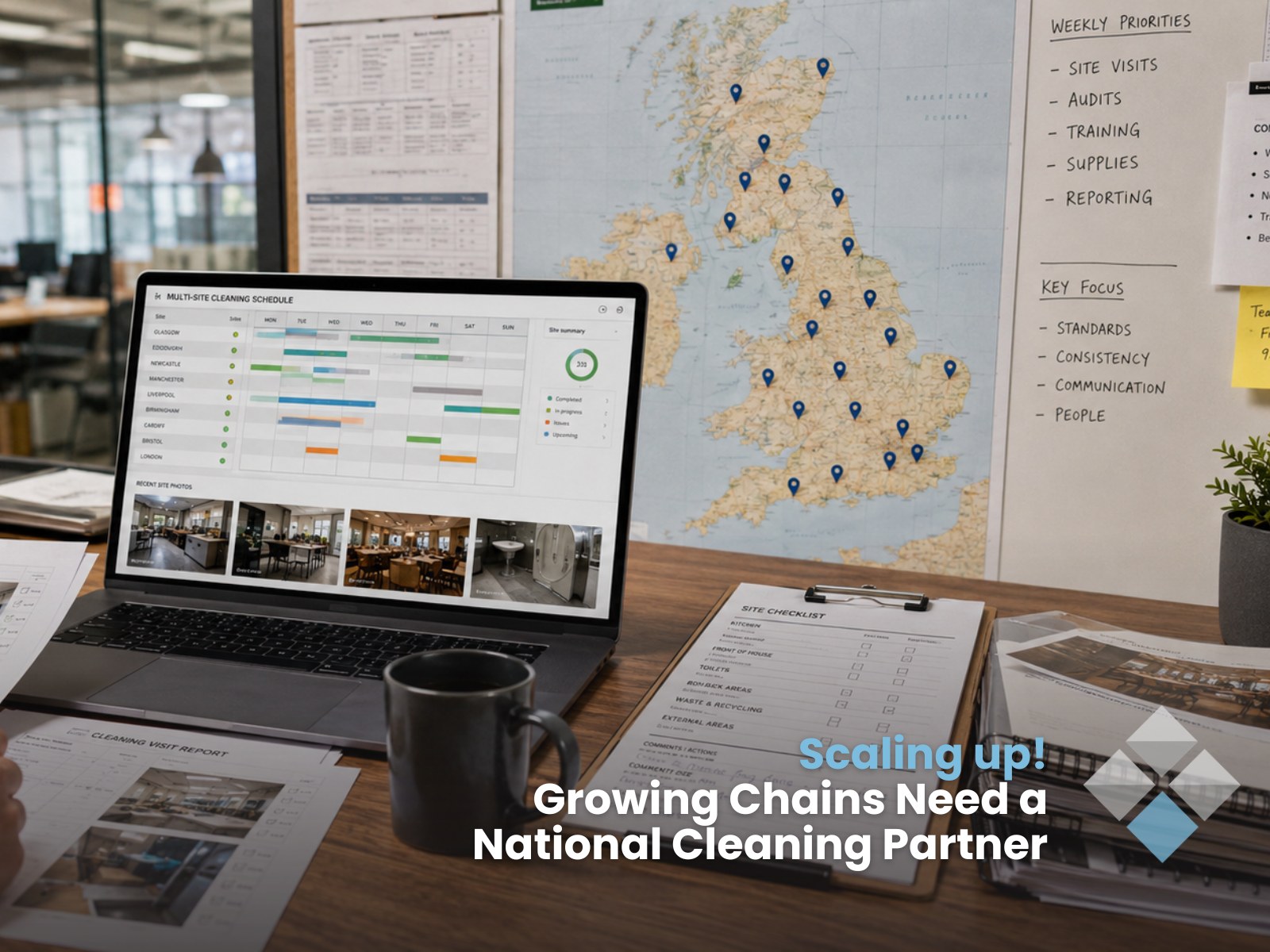
That usually means clear site lists, agreed service frequencies, planned visit dates, defined scopes of work, photographic evidence, certificates where relevant, recommendations, and a simple way of seeing what has been completed and what is due next.
For head office teams, this is often where the real value sits. A national cleaning partner should not just send people to site. They should make the programme easier to manage.
“A good national cleaning programme should take pressure away from the client, not add another layer of admin. The client needs to know what has happened, what was found, what needs doing next and where the risks are. That information has to be clear enough for facilities, operations and compliance teams to use.”
Mark Biffin, Director at BCS
This becomes especially important during periods of expansion.
New openings often bring a rush of activity. Contractors are finishing work, equipment is being installed, staff are being trained, stock is arriving and marketing is pushing towards launch day. Cleaning can easily be treated as a final step, but in many cases it needs to be planned earlier.
A new site may need a builders clean, a kitchen deep clean, extraction checks, high-level cleaning, front-of-house presentation cleaning, HVAC attention or fire damper testing depending on the building and fit-out. If that work is not scheduled properly, the opening team can be left chasing multiple suppliers at the worst possible moment.
A national cleaning partner can help by giving growing chains a repeatable process for new sites. Instead of treating every opening as a one-off scramble, the business can build a standard cleaning and compliance checklist that is adjusted for each location.
That same thinking applies to existing sites.
Once a chain is growing, older sites can be neglected because attention naturally moves to the next opening. The first five sites may still be trading strongly, but their extraction systems, deep cleaning schedules, HVAC systems or high-level areas may now be several months behind where they should be. Growth can create a false sense that the newest sites are the priority, when the established sites may carry more operational risk because they have been running longer.
A proper planned programme helps keep both sides in view. New sites get the support they need before launch, and existing sites remain on a clear maintenance cycle.
For growing brands, the warning signs are usually easy to recognise.
Reports are stored in too many places. Site managers are chasing contractors directly. Head office does not have a single view of upcoming cleans. Different suppliers are providing different levels of evidence. Cleaning is only discussed when there is a problem. No one is completely sure which sites have the highest risk, the heaviest cooking load or the next due date.
At that point, the issue is no longer whether the company has cleaning suppliers. It is whether the company has a cleaning system.
BCS supports growing and established operators across the UK with specialist cleaning services for commercial kitchens, hospitality environments, food production sites, healthcare settings, retail locations and multi-site estates. Services include kitchen extract cleaning, kitchen deep cleaning, fire damper testing, HVAC deep cleaning, high-level cleaning, front-of-house cleaning, black mould removal, LEV system cleaning and factory and industrial cleaning.
For growing chains, the practical benefit is that multiple specialist services can be brought into a clearer programme, with structured reporting and scheduling that supports PPM planning, compliance records and asset management. BCS can provide clear documentation, photographic evidence and structured data that can be aligned with a client’s CAFM system, PPM schedule or asset register.
That matters because the right national partner should not make the relationship feel distant. The aim is not to replace local understanding with a faceless national contract. The aim is to combine national coverage with proper coordination, reliable communication and site-level attention.
If your business is moving from a handful of sites into a larger estate, this is the right time to look at how cleaning is being managed.
Not when the first gap appears. Not when a report is missing. Not when a landlord, insurer, auditor or Environmental Health Officer asks a question that takes days to answer.
The better time is before the estate becomes too complicated to manage informally.
From five sites to fifty, cleaning needs to grow with the business. With the right programme in place, operators can keep standards consistent, support new openings, protect existing sites and give head office a much clearer view of what is happening across the estate.
BCS works with growing UK chains that need specialist cleaning delivered properly, site by site, without turning the process into a headache.
If your estate is expanding and your cleaning arrangements are starting to feel harder to control, BCS can help build a practical national programme around the way your sites actually operate.