
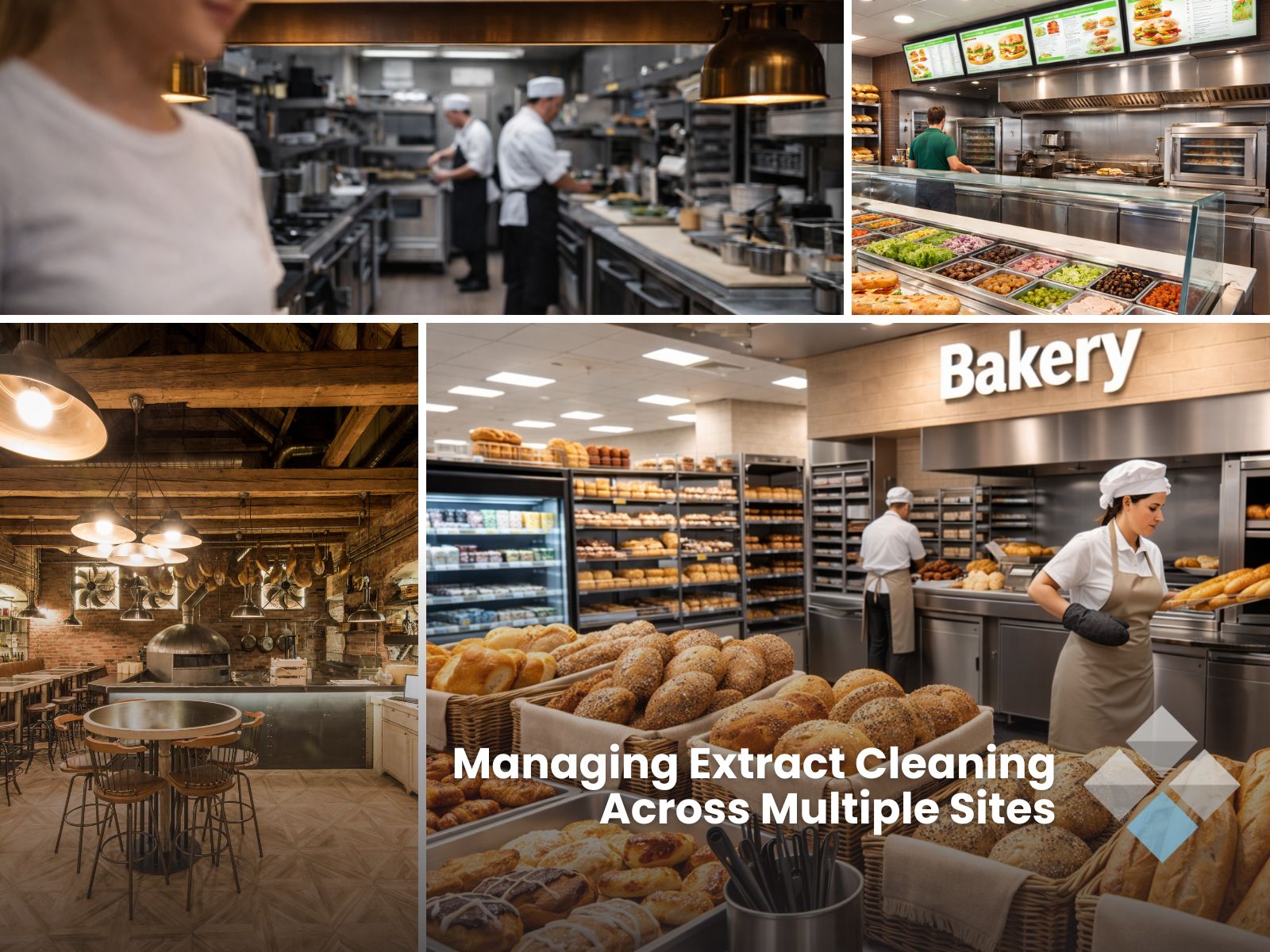
Running a single commercial kitchen is already a complex operation. Running fifty, one hundred, or several hundred across a national retail or hospitality estate is something else entirely.
For facilities and operations teams responsible for supermarket bakeries, fast casual dining brands, sandwich chains, pub groups or takeaway estates, kitchen extraction systems quickly become a network of critical assets spread across dozens of locations. Each site may have a different kitchen layout, different trading hours, and very different levels of cooking intensity.
Yet from a compliance and safety perspective, every one of those kitchens still needs to meet the same expectations around ventilation hygiene, fire risk and insurance compliance.
That is where extraction cleaning stops being a reactive maintenance job and becomes an operational programme.
Across large retail and hospitality estates, the question is rarely whether systems are being cleaned. The real challenge is knowing that they are being cleaned consistently, on schedule, and to the correct standard across every site.
“Multi-site operators don’t struggle with understanding the importance of extract cleaning,” says Liam Hodgson, Client Services Manager at BCS. “Where things become difficult is coordination. When you have fifty or a hundred kitchens across a region, you need a structured programme that tells you exactly which sites have been cleaned, what condition the system was in, and when that location needs to be visited again. Without that visibility it becomes very easy for gaps to appear.”
Those gaps matter.
Grease produced during cooking is constantly drawn into kitchen extraction systems. Over time it builds along canopy filters, ductwork, fans and internal surfaces. If it is not removed at appropriate intervals, that grease layer becomes a significant fire risk and can also reduce the performance of the ventilation system.
Fire services across the UK regularly identify grease-laden extraction systems as a contributing factor in commercial kitchen fires. For retail chains and hospitality brands operating open kitchens, food courts, in-store bakeries or quick service restaurants, keeping extraction systems clean is therefore both a safety requirement and a brand protection issue.
Extract cleaning at scale
Large estates require an approach that goes well beyond ad-hoc scheduling. When kitchens are spread across dozens or hundreds of sites, extraction cleaning needs to be planned as a coordinated programme rather than a one-off task.
Facilities teams are often managing supermarket bakeries, fast casual kitchens, pub restaurants and takeaway sites all within the same estate. Each location may have different cooking volumes and layouts, but the requirement for safe, compliant ventilation remains exactly the same.
That means programmes must be delivered consistently across regions, with clear reporting and reliable scheduling.
BCS supports national and regional operators with structured extract cleaning programmes designed specifically for multi-site estates. This includes work with retail and hospitality clients such as Sainsbury’s Local stores and Marston’s pubs and restaurants across Wales, where extraction systems must be maintained across multiple locations with consistent standards and documented compliance.
With dedicated mobile cleaning teams operating across the UK, BCS technicians specialise in kitchen extract and duct cleaning in line with TR19 industry guidance. Each visit includes inspection of the canopy, ductwork and fan system, full cleaning where required, and detailed reporting to support fire risk assessments and compliance records.
“Consistency is the biggest concern for facilities teams managing large estates,” says Mark Biffin, Director at BCS. “If you have kitchens spread across the country, you need confidence that every site is being cleaned to the same technical standard. It shouldn’t matter whether the team is working in Swansea, Bristol or Manchester. The process, the reporting and the quality of the clean all need to be the same.”
He adds:
“Where operators really see the benefit is when the cleaning programme becomes predictable. Once you have a structured schedule in place and proper documentation after every visit, it takes a lot of pressure off facilities managers. They can see exactly where the estate stands from a compliance point of view rather than constantly chasing individual sites.”
Integrating cleaning programmes into facilities management systems
One of the biggest operational improvements for multi-site organisations is integrating extract cleaning into their wider Planned Preventative Maintenance schedule.
Rather than managing cleaning visits manually, many facilities teams now coordinate ventilation maintenance through CAFM or PPM systems. This allows sites to be tracked alongside other compliance tasks such as fire safety inspections, equipment servicing and general maintenance.
BCS works with facilities teams to ensure extract cleaning schedules align with these systems. After each visit, technicians generate reports with photographic evidence and certification documentation that can be uploaded to the organisation’s compliance records.
This approach provides a clear audit trail across the estate and helps facilities managers maintain oversight of ventilation hygiene across multiple locations.
Operational considerations for large kitchen estates
While every estate is different, facilities teams managing multiple kitchens often focus on a few core operational factors when planning extract cleaning programmes.
| Operational Factor | Why It Matters for Multi-Site Estates |
|---|---|
| Site scheduling | Cleaning visits must be coordinated across regions without disrupting trading hours |
| Compliance documentation | Certificates and reports must be available for insurers and fire risk assessments |
| System condition visibility | Facilities teams need clear reporting on the condition of ductwork and components |
| Regional coverage | Contractors must be able to reach multiple locations efficiently |
| Technical consistency | Cleaning standards should be consistent across all sites regardless of location |
When these factors are managed effectively, ventilation cleaning becomes part of a predictable maintenance cycle rather than a reactive task.
Supporting growing estates
As retail and hospitality brands grow, ventilation maintenance programmes often need to grow with them. What starts as a small number of sites can quickly turn into a national estate of kitchens that all need to be maintained safely, consistently and on schedule.
For facilities teams managing fast casual restaurants, supermarket bakeries, sandwich shops, pub kitchens or takeaway operations, extraction systems become one of the most important assets to manage across the estate. Without a structured programme in place, it becomes difficult to track when systems were last cleaned, which locations are due next, and whether each site is meeting compliance expectations.
That is why many operators move towards a planned, estate-wide approach to extraction cleaning as their footprint grows.
Specialist contractors with the capacity to support multi-site estates can help maintain consistency as organisations scale. With mobile cleaning teams operating across the UK and technicians focused specifically on extraction and duct cleaning, BCS supports retail and hospitality operators with programmes designed for large estates rather than individual sites.
For facilities managers responsible for dozens of kitchens, the objective is straightforward. Extraction systems need to remain clean, compliant and operating efficiently across every location.
But achieving that consistently across a large estate requires more than periodic cleaning visits. It requires coordination, clear reporting and a contractor that understands the operational realities of multi-site retail and hospitality businesses.
